
‘ZINT’s Salesforce integration has provided us a clear way of visualising our white space and re-engaging our latent pipeline in a highly effective way.’
REPORTED · DPD UK · Case study
Whitespace mapping
‘Whitespace’ is every company that fits your offer and is missing from your CRM. ZINT finds it in two moves. First it widens the market, reading filings, trade records and websites to find the companies that SIC codes and contact databases miss. Then it matches your CRM by UK company number and ranks what is left.
Evidence for the plan.
Where your market sits
Each dot is 1% of the ideal-fit UK market
30%
In your CRM
Valid, correctly attributed
34%
Findable, not in your CRM
Missing, duplicated or misrecorded
36%
Structurally hidden
Invisible to SIC, vendor and web filters
MODELLED · ZINT · CRM to Actual Visibility · Nov 2026 · 40+ customer and prospect conversations, 2025 to 2026, with Companies House, HMRC, DBT and DESNZ statistics
Across logistics, financial services, tax advisory, energy and insurance, a typical UK B2B seller holds valid CRM records for about three in ten of the ideal-fit companies in its market. The modelled range runs from 20% to 42%.
Coverage looks higher at first. It falls from 38% to 30% once duplicates, dissolved companies and misattributed group entities are taken out.
Visibility is valid, correctly attributed CRM records divided by the ideal-fit UK companies in the market. The 30% is a simple average of the five sectors.
MODELLED · ZINT · CRM to Actual Visibility · Nov 2026 · 40+ customer and prospect conversations, 2025 to 2026, with Companies House, HMRC, DBT and DESNZ statistics
Most prospect lists start from SIC codes, contact databases and websites. In ZINT’s analysis, 36% of an ideal-fit market sits where those filters cannot see. So ZINT widens the market first, by reading the records behind every active UK company.
The buyer sits behind a holding company, a subsidiary or a different trading name.
What ZINT reads
The register’s group structure, owners and directors, so each trading company links to its parent and its sisters.
Importing, R&D or heavy energy use is buried inside a broader business.
What ZINT reads
HMRC’s monthly trade records, the words in the filed accounts and the energy figures large companies disclose. Magic Insights then asks each company your qualifying question.
Chosen at incorporation and rarely updated. In ZINT’s analysis, 15% to 20% of companies use catch-all codes.
What ZINT reads
What each company sells, from 22 sections of its website and 77 tagged sections of its filed accounts.
Websites, domains and vendor records lag behind what companies actually do.
What ZINT reads
The filings themselves. In the 30 days to 18 November 2026, 316,236 companies filed new accounts, and ZINT reads them.
MODELLED · ZINT · CRM to Actual Visibility · Nov 2026 · 40+ customer and prospect conversations, 2025 to 2026, with Companies House, HMRC, DBT and DESNZ statistics
PUBLISHED · ZINT · API schema and data coverage · 19 Nov 2026 · data.zint.io
FILED · Companies House, counted by ZINT · Accounts filed 20 Oct to 18 Nov 2026 · ZINT API, 19 Nov 2026
Widen the market.
Start from every active UK company. Read filings, trade records and websites to find the ones that fit, whatever their SIC code says.
Match your CRM to it.
Each account needs one identifier that a seller cannot mistype. In the UK that is the Companies House company number.
Take out what you hold.
Customers, open opportunities and any company you must not approach.
Rank what is left.
So the first call goes to the best account.
Step two is where most teams stall. Company names drift between ‘Ltd’ and ‘Limited’, between a trading name and a legal one. The company number stays the same in every system.
A Salesforce user at an energy company put the aim to us plainly:
‘I just want to be able to filter out everything that I’ve got.’
REPORTED · Energy company · Sales call
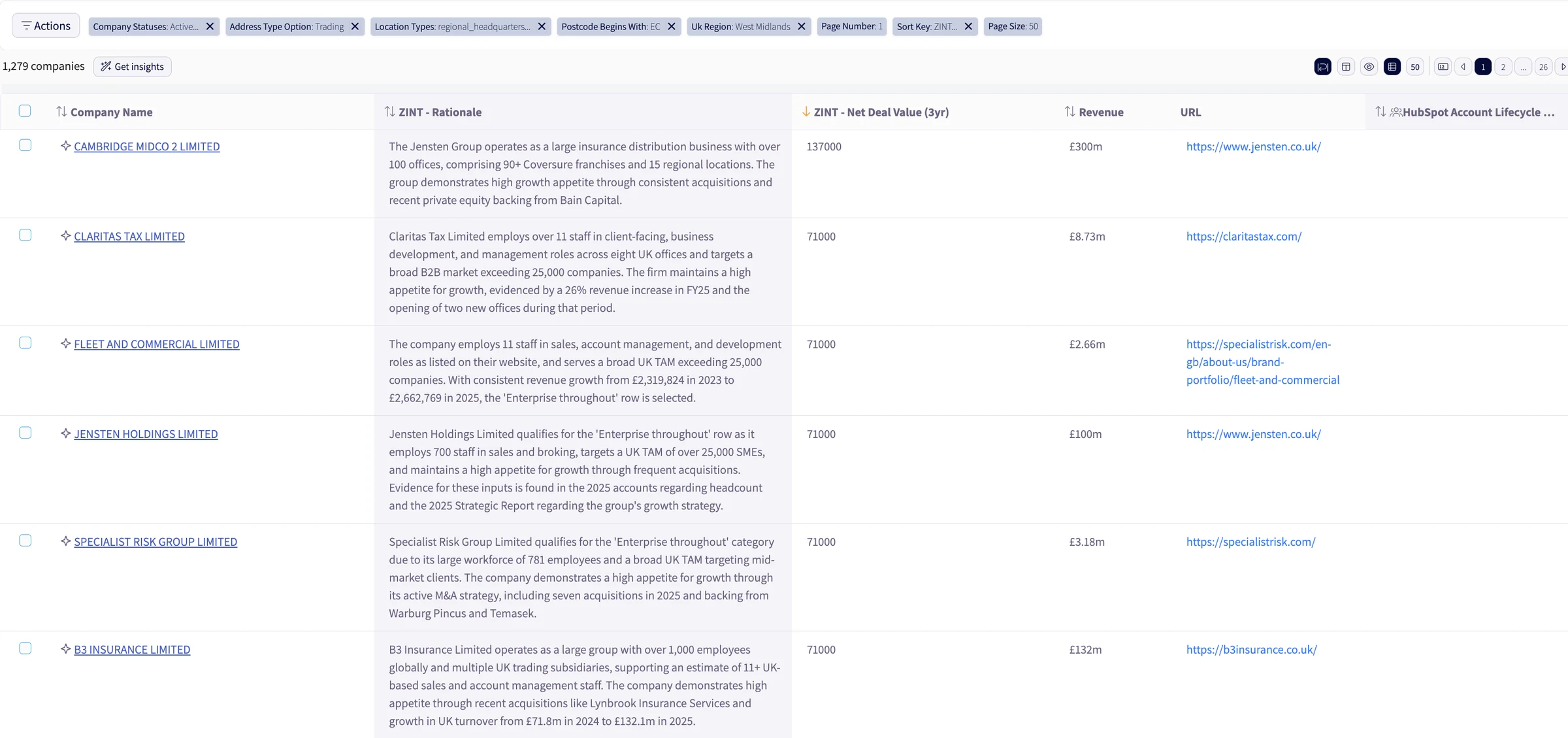
PUBLISHED · ZINT · Platform screen · internal values removed
HubSpot, Salesforce, Microsoft Dynamics 365, Zoho CRM and Pipedrive.
ZINT matches your records to UK company numbers, refreshes matched records every day and checks for an existing record before it creates a new one.
PUBLISHED · ZINT · CRM integration guide · May 2026
On a call in February 2026 we ran the check on our own demo CRM. We selected 50 companies from one search and asked ZINT to export them. One was already a record. The other 49 were missing.
ILLUSTRATION · ZINT · Export check on ZINT’s own demo CRM · 9 Feb 2026 · Customer call
Your own numbers will differ. The check is the same: every company is found or missing, by company number, before anything is created.
Whitespace mapping happens at stage two, data testing, before any modelling. Your super user and your CRM owner are in the room.
| Stage | What happens | What you leave with |
|---|---|---|
| 2 Data testing | Customers and opportunities are uploaded. An opt-out list is created. The two-way data map is tested. Duplicates are removed. The whitespace is mapped | A tested two-way data map between ZINT and your CRM |
PUBLISHED · ZINT · Customer Success Plan · Oct 2026
Each result below was reported by the customer.
‘ZINT’s Salesforce integration has provided us a clear way of visualising our white space and re-engaging our latent pipeline in a highly effective way.’
REPORTED · DPD UK · Case study

‘We needed a solution which provided the team with visibility into which organisations had already been contacted and the remaining “white space” opportunities.’
REPORTED · Central FX · Sales Manager · Case study
Without them there is nothing to match on. ZINT can run a matching project first. It works from the company name, any company number you hold, the website, the switchboard number and the address.
Where one company has two CRM records, ZINT cannot choose between them. Clean them up first.
ZINT syncs with one type of CRM record, usually Company or Account.
A company can be absent from your CRM for a good reason. Rank the list before anyone dials.
Whitespace is every company that fits your offer and is missing from your CRM. You find it by subtraction: your whole market, minus the accounts you already hold.
In ZINT’s analysis across five sectors, a typical UK B2B seller holds valid CRM records for about 30% of its ideal-fit market, from 21% in tax advisory to 42% in energy. Your own figure comes from matching your CRM to UK company numbers.
Companies choose a SIC code at incorporation and rarely update it, and many choose a catch-all code. A buyer can also sit behind a group company or a different trading name. ZINT reads filings, trade records and websites as well, so the market starts wider.
Match your CRM accounts to UK company numbers. Then search your market with those numbers excluded. ZINT Platform does both.
ZINT can run a matching project first. It works from the company name, any company number you hold, the website, the switchboard number and the address.
Yes. Customers, open opportunities and an opt-out list are loaded at stage two of onboarding, before any search is relied on.
Yes. Import a field such as last activity date, then filter on it. Accounts with no recent activity come back as a list.
HubSpot, Salesforce, Microsoft Dynamics 365, Zoho CRM and Pipedrive. ZINT matches your records to UK company numbers, refreshes matched records every day and checks for an existing record before it creates a new one.
No. ZINT does not sell personal contact data. It shows you which companies to approach, and why. A company profile carries the directors on the register and the company’s published phone number, website and social media links. Where a company’s website publishes its directors’ social media profiles, ZINT shows those too. For direct emails and mobile numbers, teams pair ZINT with a contact tool. Our partners provide contact details.
No. ZINT covers the UK only: every active company on the Companies House register, in depth.
You can start free with a work email. Team packages are priced on application, and the pricing page sets out what drives the price.
Tell us what you sell and to whom. In a 20-minute call, we will show you how many UK companies fit, which ones lead the list, and the filing behind each.